
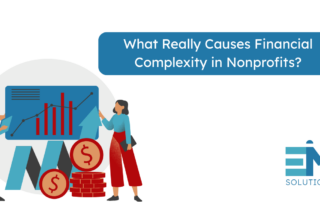
What Really Causes Financial Complexity in Nonprofits?

Financial complexity in nonprofits doesn’t appear by accident. It is built into the very structure of how we operate and fund our work.

Here are three major drivers of complexity:

1. Project-Based Structures

Most nonprofits operate multiple projects simultaneously. Each project may have:

Its own budget
Dedicated funding
Unique timelines

Specific reporting requirements

Even though the organisation has one bank account and one accounting system, internally it must track every expense against individual project budgets. This immediately multiplies your system’s requirements.

2. Different Types of Donors

Not all funders are the same.

Some want:

Line-by-line expense breakdowns
Quarterly financial reports
Specific cost categories

Custom templates

Others require:

Matching funds
Detailed payroll allocations

Separate reporting for capital vs. operational expenses

Each donor effectively creates a new “lens” through which your financial data must be presented.

The complexity is not in the money itselfit is in how it must be reported.

3. Co-Funding and Designated Income

Co-funding arrangements significantly increase reporting layers. When:

Two donors fund one project
One donor funds multiple projects
Unrestricted funds cover shortfalls

Income must be split across cost centres

… every transaction must be allocated proportionally and accurately.

That means a single salary cost, for example, might need to be divided across:

Multiple projects
Multiple donors

Different budget categories

The same data must satisfy multiple stakeholders.

The Nonprofit Reality

In the business world, detailed tracking often scales with turnover. In the nonprofit world, detailed tracking starts almost immediately.

Managing more than one grant or having designated funding streams makes complexity unavoidable, regardless of budget size.

Reflection Questions:

1. Have you mapped what must be reported, and to whom?

2. Are you intentionally managing your data and reporting requirements, or is it a last-minute scramble?

Understanding what causes complexity helps leaders make smarter structural decisions. The goal is not to eliminate complexity (that’s rarely possible), but to manage it intentionally and ensure it is properly resourced.

Give EM Solutions a call if you’d like a mentor to walk you through your current tracking. We want to see you unlock your NPO’s potential this year.
By |2026-03-23T21:32:04+02:00March 23rd, 2026|Uncategorized|0 Comments

Managing Financial Complexity Is Not Just a Finance Function

In nonprofit organisations, financial complexity is often treated as a “finance department issue.” But the truth is this: managing financial complexity is the responsibility of the entire organisation.

No matter the size of your budget, complexity is unavoidable. Even organisations managing as little as R200,000 may be required to track expenditure at a level of detail comparable to a for-profit business with a turnover of R20 million. Multiple grants, designated funding, and diverse income streams make detailed reporting non-negotiable.

The “Financial Reporting Cube”

Nonprofit financial reporting can be understood as a cube with three sides:
• Management perspective – What leadership needs to make strategic decisions.
• Project perspective – What is happening within each project.
• Donor perspective – What funders require in their specific formats.

It’s the same financial data—but sliced differently depending on the audience.

This means every transaction must be coded and categorised in multiple ways. A single expense might need to reflect:
• The organisational budget line
• The specific project
• The donor’s reporting framework

That level of complexity cannot sit only with finance.

Why This Matters for Leadership

Programmes design budgets. Fundraisers negotiate donor conditions. Operations manages procurement. Leadership approves structures.

Every decision made outside of finance directly impacts financial reporting requirements.

If programme managers don’t understand coding structures, errors increase.
If fundraisers don’t consider reporting demands, administrative costs rise.
If leadership doesn’t factor complexity into planning, staff capacity becomes overstretched.

Financial complexity affects:
• Staff time
• Software investment
• Administrative workload
• Compliance risk
• Organisational sustainability

It is not merely about bookkeeping. It is about organisational design.

The Hidden Cost of Complexity

Complexity carries real, often unfunded costs:
• Staff hours spent reconciling reports
• Investment in accounting systems
• Time spent allocating payments correctly
• Extra layers of review and compliance

If leadership does not actively manage complexity, it grows quietly—and expensively.

Financial stewardship in nonprofits is a shared responsibility. When the whole organisation understands the impact of funding structures and reporting requirements, financial systems become a strategic asset rather than a constant burden.

Reflection Questions:
1. Does your team understand the importance of financial stewardship?
2. Is your financial system working for you, or against you? Why?

Would you like a review of your financial processes? EM Solutions has a team of experienced NPO leaders standing by to ensure that your financial tools unlock your NPO’s potential.

By |2026-03-11T15:23:17+02:00March 11th, 2026|Uncategorized|0 Comments

When Your Systems Work, Your Team Can Too

Every growing nonprofit reaches a point where it becomes clear: impact is not limited by passion, but by capacity. And capacity is built through good systems.

When systems work well, teams know what to do, where to find information, and how decisions are made. This clarity creates mental space. Without it, even committed staff become tired and overwhelmed. Burnout usually comes from constant confusion, not from caring too much.

Strong Systems Support Strong Teams

Clear processes help new staff settle in faster, make delegation easier, and improve trust and teamwork. Instead of relying on people to “push through,” the organisation starts to run in a steady, predictable way, making it easier to grow without burning out your team.

Leaders Get Out of Firefighting

Many nonprofit leaders become the go-to person for every decision and problem. This is exhausting and unsustainable. Good systems share responsibility, allowing others to work confidently within clear boundaries. This frees leaders to focus on strategy, partnerships, funding, and innovation — where long-term impact is shaped.

Systems Shape Culture

Disorganised systems quietly create stress and frustration. Well-designed systems do the opposite: they support professionalism, consistency, and a sense of ownership. People are more likely to stay when their work flows and they feel supported.

Looking Ahead

Clear systems also help organisations adapt to change. You are not just fixing today’s problems; you are building resilience for the future.

Because when your systems work, your team can too.

Reflection Questions:

1. Do our systems make work easier or harder for our team?
2. What is one small systems improvement we could commit to this quarter?

If this series has highlighted gaps in your systems, that’s a good thing.

Start small, be consistent, and improve as you go. Streamlined systems are not about perfection; they are about helping your people and your mission thrive.

Give EM Solutions a call if you’d like to discuss this topic further, get an independent facilitator in to assist, and unlock your NPO’s potential.

By |2026-03-11T11:45:24+02:00March 1st, 2026|Uncategorized|0 Comments

How to Map Processes in Your Organisation

If Blog 1 was about understanding how your organisation works, this article is about making that work visible. Simply put: you cannot improve what you cannot see.

Process mapping may sound technical, but its just writing down the steps involved in getting something done. For nonprofits, it is one of the quickest ways to reduce confusion and build organisational resilienceand it doesn’t require expensive consultants or complex software.

What Is Process Mapping?

Process mapping documents a process from start to finish. For example:
A donor enquiry → response → information captured → proposal drafted → finance input → leadership approval → donor feedback.

Seeing the full flow often reveals duplicated steps, unclear ownership or unnecessary delays.

Why This Matters for South African NPOs

Local NPOs operate in fast-changing environments with limited resources. Without clear processes, reporting becomes stressful, audits feel overwhelming, donor communication slips, and programme quality can vary. Mapping processes strengthens governance and protects teams from avoidable pressure. It is not about bureaucracy. It’s about stability.

Start Small

Avoid trying to map everything at once. Begin with processes that are:

High-risk (finance, compliance, safeguarding)
Frequently repeated
Dependent on one person
Known pain points

Small wins create momentum.

A Simple 5-Step Approach

Using a whiteboard, shared doc or sticky notes, work through these questions with the people involved:

1. What triggers the process?
2. What happens next?
3. Who is responsible?
4. Where do delays occur?
5. What could be simplified?

Expect Some Discomfort

Process mapping can reveal role confusion, informal workarounds, or decisions sitting with one leader. Treat this as growth, not criticism. Healthy organisations are learning organisations.

Tools Come Later

Strategy first, tools second. Remember, tools should strengthen good systems, not compensate for unclear ones.

Looking Ahead:
In Blog 3, we explore what becomes possible when your systems work well — from stronger teams to reduced burnout and a healthier organisational culture.

Reflection Questions:

1. Which process should you map this quarter?
2. Are decisions sitting too heavily with one person?

Is this the first time you are mapping processes? Give EM Solutions a call if you’d like a mentor to walk you through the task. We want to see you unlock your NPO’s potential this year.
By |2026-03-11T07:49:55+02:00February 23rd, 2026|Business Resources, Leadership, Uncategorized|0 Comments

Why Systems Matter More Than You Think

January often brings fresh energy and good intentions. But strong nonprofits are not driven by purpose alone they rely on clear, dependable ways of working.

When systems are unclear, teams work harder to compensate. Tasks are duplicated, approvals are chased, and people rely on memory instead of process. Over time, this leads to fatigue and limits growth. Streamlined systems reduce friction so teams can focus on impact, not admin.

This is especially true for South African NPOs, where resources are tight and staff wear multiple hats. When one person leaves or takes leave, important knowledge can disappear. Good systems protect your mission from disruption.

Don’t Start With Tools

It is tempting to jump straight into technology, but you cannot optimise what you don’t understand. Before introducing tools, ask:

What actually happens day to day?
Where do things slow down?
Who makes decisions?
Where do handovers fail?
Which processes depend on one person’s memory?

Look Beneath the Surface

Most nonprofits already have systems; they are just informal. Making these visible helps reduce dependency on individuals, strengthen accountability, and prepare for growth. This is the foundation for everything that follows.

A Quick Reality Check

Choose one recurring process and ask your leadership team to explain how it works. If you get differing answers then you’ll quickly find out where clarity is needed.

Systems Create Freedom

Good systems do not create rigidity. They speed up decisions, reduce stress, improve teamwork, and free leaders from constant firefighting. Most importantly, they create space for strategic thinking.

Looking Ahead:
In Blog 2, we explore a simple way to map your processes so your systems truly support your mission.

Reflection Questions:

1. Where does work bottleneck in your organisation?
2. Which processes would struggle if a key person left?

Would you like help to review your systems? EM Solutions has a team of experienced NPO leaders standing by to ensure that your systems bring strength to your organisation. We want to see you unlock your NPO’s potential this year.

By |2026-03-11T11:49:01+02:00February 16th, 2026|Uncategorized|0 Comments

Retrenchment Provision

Every NPO, at some time, will have to restructure and possibly retrench a staff member.  It’s vital that you hold enough funds to meet the legal requirements for retrenchment. Here’s a quick summary of the key things you need to know.

In South Africa, retrenchment packages (sometimes called severance packages) are governed by the Labour Relations Act (LRA) and the Basic Conditions of Employment Act (BCEA).

Under Section 41 of the BCEA, an employer must pay retrenched employees:

– At least 1 week’s remuneration (salary or wages, allowances, benefits and any other regular payments) for every completed year of service
– Accrued leave pay i.e. payment for any outstanding annual leave they have not taken

Employees are also entitled to notice of termination. If retrenchment is immediate, he/she is entitled to payment in lieu of notice as per their contract or the BCEA:

– 1 week if employed for 6 months or less
– 2 weeks if employed more than 6 months but less than 1 year
– 4 weeks if employed for 1 year or more

Lastly, employees are entitled to payment of any other contractual benefits as per their contract (medical aid contributions, pension or provident fund payouts, pro-rata bonus entitlements, other perks).

What does this look like in practice?

Let’s say John receives a monthly salary of R12,000 and has worked for your organisation for 5 full years. He has 10 days of outstanding leave. Here’s the calculation:

John’s minimum statutory benefits = R31,383.55

Severance pay (1 week per completed year) = R13,846.15

Notice pay (4 weeks) = R12,000

Accrued leave (10 days) = R5,537.40

Planning ahead

A wise NPO ensures it has funds in reserve should the worst happen. It’s best practice to put this money into an investment account that earns more than inflation. Every year, when salaries are increased, the calculations need to be updated to stay current.

Retrenchment is not nice, but preparing for the possibility mitigates disaster and turns it into a more positive outcome for both your employee and your organisation.

7 July 2025

By |2026-03-11T11:52:33+02:00July 7th, 2025|Financial Management, Uncategorized|0 Comments

We welcome the new Cape Chamber President

EM Solutions welcomes the incoming Cape Chamber of Commerce President Mr Geoffrey Jacobs who takes over the reins from Janine Myburgh.

Geoff holds a Master degree in Business management and currently focuses his business efforts on Human Resources with over 22 years of experience.  As a former school principal, he also brings a deep understanding of the education system.

The new Deputy President is Jacque Moolman, a Swiss-trained hotelier and current GM of the Tsogo Sun Waterfront hotel in Cape Town.

Also voted in by the Board is Stephane Rogovsky, CEO of R-Squared Digital SA, who will join me Bruce Wade to head up the Innovation and Digital Portfolio Committee at the Chamber.

We look forward to working with the new leadership and helping develop a solid and positive impact in the business sector well into the future.

A big thanks must be extended to Janine for her awesome and impactful 5 years as President of the chamber. We have seen her personality impact every aspect of the business sector in Cape Town and across the globe. She leaves big shoes to fill and a legacy that will remain for many years to come.

By |2026-03-11T11:53:13+02:00March 12th, 2019|Uncategorized|0 Comments

Business Sprint 2018 – Branding

This week we unpacked some of the issues around our company branding from Purpose to Slogan and everything in between. Too often these things are just ignored or passed over for other more important items on our busy agendas as business owners.

Take a few minutes to watch this video and make some notes on what may need some attention for your brand before the end of 2018.


By |2018-11-09T09:29:39+02:00November 9th, 2018|Entrepreneurship, Year-end planning|1 Comment

Business Sprint 2018 – Staff

As a part of our final sprint for 2018, we are looking at 10 key areas of your business that could give you that added advantage in the final push before Christmas.

Last week we looked at staffing issues and we reviewed 7 R’s related to how we deal with staff. Here is a short summary:

1. Respect – always show respect to your staff by greeting them, listening to them and saying thank you at the end of each day.

2. Refine – Constant training and education is key to refining staff to fit into your changing business and to become effective for your vision.

3. Rejoice – learn to celebrate both success and failure and always learn from both.

4. Reward – Paying your staff and rewarding them with gratitude is key to retention and the longevity of your business.

5. Repair – always fix what is broke. Learning to understand your staff’s home, emotional and physical situations are key to helping to offer support and solutions to fix what may be wrong.

6. Renew – Change is constant, but often we stagnate in our own companies. Mix things up a bit and renew things in the office. You will see the results.

7. Rest – Take time off. Give staff leave and time off for their resting and rejuvenating. The investment in rest will be well rewarded.

This week we big our focus on Marketing and Branding as we unpack some interesting facts on what you can do this week to improve your market penetration and retention.

Join us on Wednesday at 12:00 Noon: https://zoom.us/j/723567165

By |2018-10-29T12:44:45+02:00October 29th, 2018|Year-end planning|0 Comments

Rules for Prototyping

A recent article on Techco by Tishin Donkersley gives us some simple rule to know when developing your idea from ideation to prototype stage. Here is what she had to say:

  1. Have a Purpose and a Plan
  2. It doesn’t have to be perfect
  3. It’ll take longer than you think
  4. The design will change
  5. Quality = Cost
  6. Find a Mentor

We fully agree with each of these and encourage our innovation clients to come prepared for failure, iteration and a journey of exploration of both themselves and their product.

To read the full article: http://go.conceptdesign.co.za/what-you-need-to-know#https://tech.co/6-tips-prototyping-idea-scratch-2017-11

By |2018-09-17T10:47:49+02:00September 17th, 2018|Uncategorized|0 Comments