
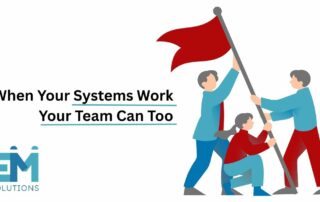
When Your Systems Work, Your Team Can Too

Every growing nonprofit reaches a point where it becomes clear: impact is not limited by passion, but by capacity. And capacity is built through good systems.

When systems work well, teams know what to do, where to find information, and how decisions are made. This clarity creates mental space. Without it, even committed staff become tired and overwhelmed. Burnout usually comes from constant confusion, not from caring too much.

Strong Systems Support Strong Teams

Clear processes help new staff settle in faster, make delegation easier, and improve trust and teamwork. Instead of relying on people to “push through,” the organisation starts to run in a steady, predictable way, making it easier to grow without burning out your team.

Leaders Get Out of Firefighting

Many nonprofit leaders become the go-to person for every decision and problem. This is exhausting and unsustainable. Good systems share responsibility, allowing others to work confidently within clear boundaries. This frees leaders to focus on strategy, partnerships, funding, and innovation — where long-term impact is shaped.

Systems Shape Culture

Disorganised systems quietly create stress and frustration. Well-designed systems do the opposite: they support professionalism, consistency, and a sense of ownership. People are more likely to stay when their work flows and they feel supported.

Looking Ahead

Clear systems also help organisations adapt to change. You are not just fixing today’s problems; you are building resilience for the future.

Because when your systems work, your team can too.

Reflection Questions:

1. Do our systems make work easier or harder for our team?
2. What is one small systems improvement we could commit to this quarter?

If this series has highlighted gaps in your systems, that’s a good thing.

Start small, be consistent, and improve as you go. Streamlined systems are not about perfection; they are about helping your people and your mission thrive.

Give EM Solutions a call if you’d like to discuss this topic further, get an independent facilitator in to assist, and unlock your NPO’s potential.

By |2026-03-01T21:37:18+02:00March 1st, 2026|Uncategorized|0 Comments

How to Map Processes in Your Organisation

If Blog 1 was about understanding how your organisation works, this article is about making that work visible. Simply put: you cannot improve what you cannot see.

Process mapping may sound technical, but its just writing down the steps involved in getting something done. For nonprofits, it is one of the quickest ways to reduce confusion and build organisational resilienceand it doesn’t require expensive consultants or complex software.

What Is Process Mapping?

Process mapping documents a process from start to finish. For example:
A donor enquiry → response → information captured → proposal drafted → finance input → leadership approval → donor feedback.

Seeing the full flow often reveals duplicated steps, unclear ownership or unnecessary delays.

Why This Matters for South African NPOs

Local NPOs operate in fast-changing environments with limited resources. Without clear processes, reporting becomes stressful, audits feel overwhelming, donor communication slips, and programme quality can vary. Mapping processes strengthens governance and protects teams from avoidable pressure. It is not about bureaucracy. It’s about stability.

Start Small

Avoid trying to map everything at once. Begin with processes that are:

High-risk (finance, compliance, safeguarding)
Frequently repeated
Dependent on one person
Known pain points

Small wins create momentum.

A Simple 5-Step Approach

Using a whiteboard, shared doc or sticky notes, work through these questions with the people involved:

1. What triggers the process?
2. What happens next?
3. Who is responsible?
4. Where do delays occur?
5. What could be simplified?

Expect Some Discomfort

Process mapping can reveal role confusion, informal workarounds, or decisions sitting with one leader. Treat this as growth, not criticism. Healthy organisations are learning organisations.

Tools Come Later

Strategy first, tools second. Remember, tools should strengthen good systems, not compensate for unclear ones.

Looking Ahead:
In Blog 3, we explore what becomes possible when your systems work well — from stronger teams to reduced burnout and a healthier organisational culture.

Reflection Questions:

1. Which process should you map this quarter?
2. Are decisions sitting too heavily with one person?

Is this the first time you are mapping processes? Give EM Solutions a call if you’d like a mentor to walk you through the task. We want to see you unlock your NPO’s potential this year.
By |2026-02-23T18:14:54+02:00February 23rd, 2026|Business Resources, Leadership, Uncategorized|0 Comments

Why Systems Matter More Than You Think

January often brings fresh energy and good intentions. But strong nonprofits are not driven by purpose alone they rely on clear, dependable ways of working.

When systems are unclear, teams work harder to compensate. Tasks are duplicated, approvals are chased, and people rely on memory instead of process. Over time, this leads to fatigue and limits growth. Streamlined systems reduce friction so teams can focus on impact, not admin.

This is especially true for South African NPOs, where resources are tight and staff wear multiple hats. When one person leaves or takes leave, important knowledge can disappear. Good systems protect your mission from disruption.

Don’t Start With Tools

It is tempting to jump straight into technology, but you cannot optimise what you don’t understand. Before introducing tools, ask:

What actually happens day to day?
Where do things slow down?
Who makes decisions?
Where do handovers fail?
Which processes depend on one person’s memory?

Look Beneath the Surface

Most nonprofits already have systems; they are just informal. Making these visible helps reduce dependency on individuals, strengthen accountability, and prepare for growth. This is the foundation for everything that follows.

A Quick Reality Check

Choose one recurring process and ask your leadership team to explain how it works. If you get differing answers then you’ll quickly find out where clarity is needed.

Systems Create Freedom

Good systems do not create rigidity. They speed up decisions, reduce stress, improve teamwork, and free leaders from constant firefighting. Most importantly, they create space for strategic thinking.

Looking Ahead:
In Blog 2, we explore a simple way to map your processes so your systems truly support your mission.

Reflection Questions:

1. Where does work bottleneck in your organisation?
2. Which processes would struggle if a key person left?

Would you like help to review your systems? EM Solutions has a team of experienced NPO leaders standing by to ensure that your systems bring strength to your organisation. We want to see you unlock your NPO’s potential this year.
By |2026-02-16T16:18:10+02:00February 16th, 2026|Uncategorized|0 Comments