

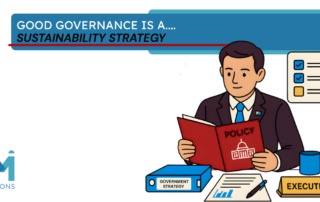
Good Governance Is a Sustainability Strategy

Governance can sometimes feel like the boring side of running an NPO. Policies. Board meetings. Minutes. Financial reports. Risk registers.

But good governance is not bureaucracy for its own sake. It is one of the foundations of sustainability.

A sustainable NPO should not depend on the personality or goodwill of its founder, director or chairperson. It needs structures that protect the organisation when circumstances change.

A good board provides more than approval for budgets. It brings oversight, skills, accountability, strategic thinking and constructive challenge.

Your board should understand:

• The organisation’s strategy
• Its financial position
• Major risks
• Legal and compliance responsibilities
• Organisational performance
• Leadership succession
• Major relationships

The Zoe Project in Cape Town, for example, identifies strategic planning, financial oversight, risk management, policy development and organisational sustainability among the responsibilities of its board.

Good governance also protects trust.

Funders, communities, staff and partners need confidence that an organisation manages its resources responsibly.

This doesn’t mean every small NPO needs complicated systems. It means every NPO needs appropriate systems for its size and risk.

Try this
Ask your board: If our founder or director left tomorrow, would our governance structures be strong enough to protect the organisation?

If the answer is uncertain, that’s a sustainability conversation worth having.
By |2026-11-02T11:28:10+02:00November 2nd, 2026|Uncategorized|0 Comments

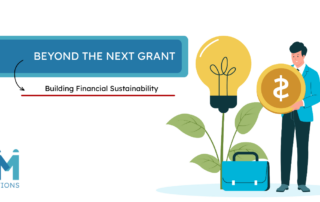
Beyond the Next Grant: Building Financial Sustainability

For many NPO leaders, sustainability immediately means one thing: funding.

And funding matters. But financial sustainability is much more than finding the next grant.

The real question is: How resilient is our income model?

Imagine that 70% of your income comes from one donor. Your organisation may look financially healthy, but it is highly vulnerable. If that donor changes priorities, your entire organisation could be affected.

Diversification is therefore important.

Depending on your mission, your income mix might include trusts and foundations, corporates, individual donors, monthly giving, government contracts, international donors, memberships, training, consultancy or earned income. The answer will be different for every NPO.

The goal isn’t to chase every possible funding opportunity. It is to develop income streams that fit your mission and reduce unnecessary vulnerability.

Taking Care of Business provides an interesting South African example. Its work combines enterprise development, social impact and a circular economy approach, creating a model that includes significant self-generated income.

But financial sustainability also requires good financial management. Know your monthly operating costs. Understand restricted and unrestricted income. Monitor cash flow. Know how dependent you are on your largest donor.

And build reserves. A reserve isn’t wasted money. It is breathing space when funding is delayed or unexpected costs arise.

Try this

Calculate: What percentage of our annual income comes from our largest funder?

If the answer makes you uncomfortable, you’ve found an important sustainability priority.
 

By |2026-10-26T10:08:26+02:00October 19th, 2026|Uncategorized|0 Comments